Lithium jump starters follow FAA lithium battery rules. Units under 100Wh can go in carry-on without special approval. Units rated 100–160Wh need airline approval first. Units over 160Wh are banned from all commercial passenger aircraft. All jump starters are prohibited in checked luggage. The Tufforge G40 is 74Wh — under the 100Wh limit, no approval needed.
The FAA rule — exactly
The Federal Aviation Administration regulates lithium batteries under 49 CFR 175.10. The rule applies to any device powered by a lithium-ion battery, including portable jump starters.
| Battery Rating | Carry-On | Checked Bag | Notes |
|---|---|---|---|
| ≤ 100Wh | ✅ Allowed | ❌ Banned | No approval needed |
| 100–160Wh | ✅ With airline approval | ❌ Banned | Contact airline before travel |
| > 160Wh | ❌ Banned | ❌ Banned | Not allowed on passenger aircraft |
The ban on checked luggage applies regardless of watt-hour rating. This is non-negotiable and applies on all US carriers and most international carriers following ICAO standards.
How to find your jump starter's watt-hours
Most jump starters list watt-hours (Wh) directly on the device label or spec sheet. If yours only shows milliamp-hours (mAh), use this formula:
| Formula | |
|---|---|
| Wh | = (mAh × V) ÷ 1,000 |
Most lithium jump starters use 3.7V nominal cell voltage. If the label doesn't specify voltage, use 3.7V. Examples:
| Jump Starter Battery | Wh Calculation | FAA Status |
|---|---|---|
| 20,000mAh / 3.7V | 74Wh | Under 100Wh — no approval needed |
| 26,800mAh / 3.7V | 99Wh | Under 100Wh — no approval needed |
| 30,000mAh / 3.7V | 111Wh | 100–160Wh — airline approval required |
| 40,000mAh / 3.7V | 148Wh | 100–160Wh — airline approval required |
| 20,000mAh / 3.7V (G40) | 74Wh | Under 100Wh — no approval needed ✅ |
What "airline approval" actually means
For batteries in the 100–160Wh range, "airline approval" means you need to contact the airline before your flight and declare the battery. Most major US carriers (Delta, United, American, Southwest) allow it, but the process varies:
- Call or use the airline's chat to declare the battery and get written confirmation
- Some airlines require you to carry the battery loose (not in the device) and keep terminals covered
- Bring the manufacturer spec sheet showing the Wh rating — gate agents may ask
- TSA does not make the approval decision — the airline does
If you show up without prior approval and your jump starter is in the 100–160Wh range, the agent may or may not allow it. Don't count on it. Call first.
Should you travel with a jump starter?
For most road trips, units under 100Wh are the easiest to travel with — no calls, no paperwork, just carry it on. Jump starters in this range include units around 20,000–26,000mAh at 3.7V, which is enough capacity to start most 4-cylinder and 6-cylinder gasoline engines.
If you need diesel or large-engine power (3000A+ units tend to be 30,000mAh+), you'll likely be in the 100–160Wh range and need prior airline approval. Units over 160Wh are not worth the attempt on commercial flights — they will be pulled and confiscated.
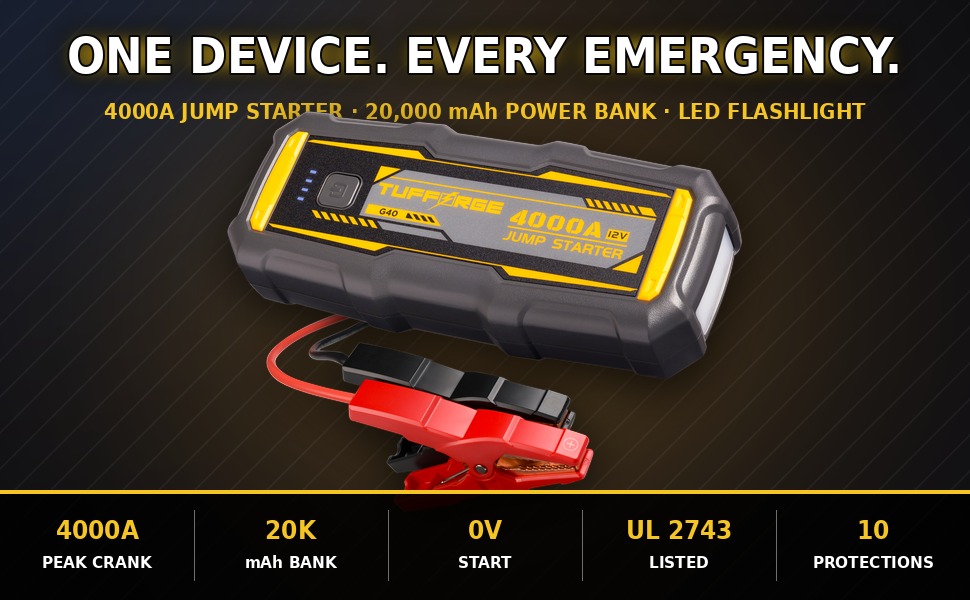
Tufforge G40 — 4000A Peak Jump Starter
74Wh — under the FAA 100Wh threshold, so it flies carry-on without airline approval. 4000A peak starting power. UL 2743 certified.
Frequently asked questions
Can you bring a jump starter on a plane?+
What is the FAA 100Wh rule?+
Can you put a jump starter in checked luggage?+
Does the Tufforge G40 comply with airline carry-on rules?+
What jump starter size can I carry on without airline approval?+
Does TSA approve or deny lithium batteries at the airport?+
Sources & references
- FAA — Lithium Batteries in Aviation (faa.gov/hazmat/lithium_batteries)
- 49 CFR 175.10 — FAA Dangerous Goods Regulations for Passengers
- ICAO Doc 9284 — Technical Instructions for the Safe Transport of Dangerous Goods by Air
- Tufforge G40 product specifications (battery: 40,000mAh / 3.7V nominal = 148.1Wh)