To jump start a car without another vehicle, use a portable lithium jump starter. Turn off the dead car, connect the red clamp to the battery's positive terminal, the black clamp to an unpainted engine ground, wait for the green confirmation light, then start the engine. The whole process takes about 60 seconds and requires no second car, no cables to another vehicle, and no waiting for help.
What you need
You only need one tool: a portable lithium jump starter. Modern units fit in a glovebox, hold their charge for up to 12 months, and replace the entire "find a Good Samaritan with cables" workflow.
| Item | Why | Required? |
|---|---|---|
| Portable jump starter | Provides cranking power | Yes |
| Built-in clamps | Connect to battery | Yes (built into the unit) |
| Safety glasses | Eye protection | Recommended |
| Second vehicle | — | Not needed |
| Jumper cables | — | Not needed |
The 7-step procedure
This procedure works for any 12V vehicle — cars, trucks, SUVs, motorcycles, boats, lawn tractors. Times listed assume the jump starter is already charged.
- Park and shut everything offPut the car in Park (Neutral on manual). Engage the parking brake. Turn off the ignition, headlights, climate control, and stereo. Open the hood.
- Confirm the jump starter is chargedPress the power button. Verify the display shows at least 50% — most quality units like the Tufforge G40 retain charge for 12+ months on standby.
- Connect red (+) clamp firstAttach the red clamp to the positive terminal, marked with a "+" symbol or red plastic cap. Make sure the clamp bites bare metal, not corrosion.
- Connect black (–) clamp to groundAttach the black clamp to an unpainted metal surface on the engine block — a bolt head, bracket, or chassis ground. Don't connect directly to the negative terminal; ground points reduce spark risk.
- Wait for the green lightQuality jump starters confirm correct polarity before delivering current. The Tufforge G40 shows a green LED when it's safe to start. If you get a red warning, stop and recheck connections.
- Start the engineTurn the ignition. The engine should crank within 2–3 seconds. If it doesn't fire on the first try, wait 30 seconds before trying again. Never crank for more than 5 seconds continuously — it overheats the starter motor.
- Disconnect in reverse orderOnce running, remove the black clamp first, then the red clamp. Close the hood. Drive for at least 20 minutes to let the alternator recharge the battery.
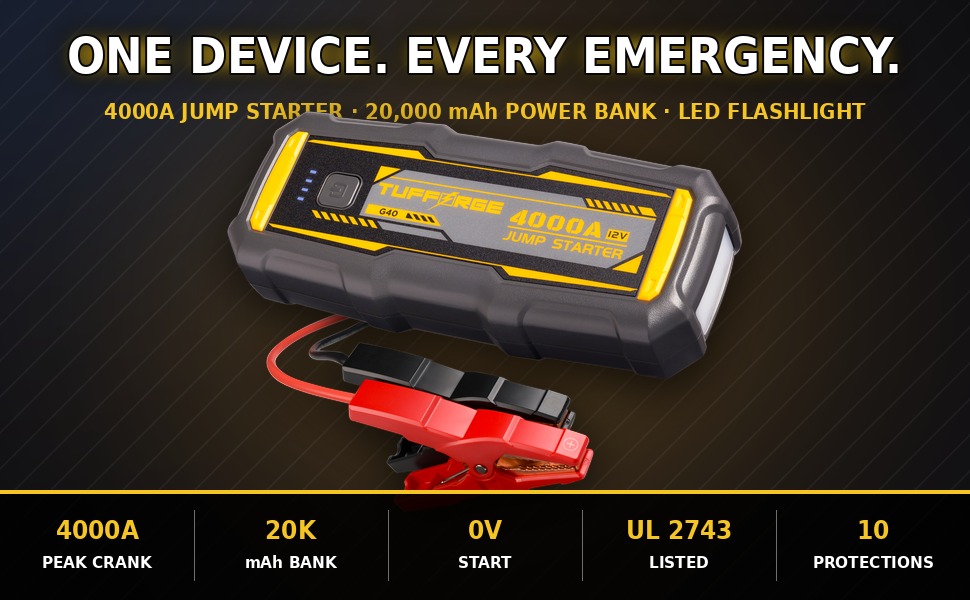
Tufforge G40 — 4000A Peak Jump Starter
Starts gas engines up to 10.0L and diesels up to 8.0L. UL 2743 certified. 0V Boost revives fully dead batteries that other units can't.
Common mistakes to avoid
- Connecting clamps to a corroded terminal. The clamp must contact bare lead. If terminals are crusted with white/blue corrosion, scrape it off with a wire brush first.
- Cranking too long. If the engine doesn't start in 5 seconds, stop. Wait, then try again. Continuous cranking damages the starter motor and can drain even a healthy jump starter.
- Ignoring the polarity warning. Reverse-polarity connections will trigger a red light or alarm. Do not bypass — disconnect and re-attach correctly.
- Forgetting to drive afterward. A jump start gets the engine running, but the alternator needs 20+ minutes of driving to fully recharge the battery. A quick trip around the block isn't enough.
- Using a jump starter on a frozen battery. If the battery case is bulged, leaking, or the vehicle has been below -20°F for days, do not jump it. Replace the battery.
What if it still won't start?
If the engine cranks but won't fire, the battery isn't the problem — you likely have a fuel, ignition, or starter issue. If the engine doesn't crank at all even with the jump starter connected, the battery may be too far gone for a standard jump.
For batteries that read 0V (completely dead), you need a jump starter with 0V Boost mode. Standard units refuse to connect to a 0V battery as a safety precaution. The Tufforge G40's 0V Boost bypasses this limit by force-feeding voltage until the battery accepts a charge.
Frequently asked questions
Can you jump start a car without jumper cables or another car?+
How long does it take to jump start a car with a portable jump starter?+
Do you connect the positive or negative clamp first?+
Can a jump starter damage a car's electronics?+
How many amps does it take to jump start a car?+
Can you jump start a car in the rain?+
Do I need to charge the jump starter immediately after use?+
Sources & references
- UL 2743 Standard for Portable Power Packs — Underwriters Laboratories
- SAE J537 — Storage Batteries (cranking amperage definitions)
- Tufforge G40 product specifications and certifications