Most gasoline cars need 400–600 cranking amps to start. Full-size trucks and SUVs need 600–1000 amps. Diesels require 1000–2000+ cranking amps. For a portable jump starter, look for 2000A peak or higher to cover nearly any consumer vehicle. The Tufforge G40's 4000A peak rating provides headroom for diesels up to 8.0L.
The amp-by-engine-size table
This is the table to bookmark. Cranking amp requirements scale with engine displacement, fuel type, and ambient temperature. Cold weather can double the amperage needed because oil thickens and chemical reactions slow.
| Engine | Type | Cranking Amps (warm) | Cold-Weather Need | Min. Jump Starter Peak |
|---|---|---|---|---|
| 1.0L–1.6L | Gas | 300–400A | 500A | 1000A |
| 1.8L–2.5L | Gas | 400–550A | 650A | 1500A |
| 2.5L–3.5L V6 | Gas | 550–700A | 800A | 2000A |
| 3.5L–5.0L V8 | Gas | 700–900A | 1100A | 2500A |
| 5.0L–7.0L V8 | Gas | 900–1100A | 1300A | 3000A |
| 2.0L–3.0L | Diesel | 800–1000A | 1300A | 2500A |
| 3.0L–5.0L | Diesel | 1000–1400A | 1700A | 3000A |
| 5.0L–8.0L | Diesel | 1500–2000A | 2500A | 4000A |
Peak amps vs cranking amps vs CCA
This is the part most marketing pages get wrong. Three different amperage ratings appear on jump starter packaging — they're not interchangeable.
- Peak Amps
- Maximum current the unit can deliver for a fraction of a second (typically 100–300ms). The flashy number on the box. Useful for breaking inertia in a stuck starter, but not a sustained measurement.
- Cranking Amps (CA)
- Current the unit can sustain for 30 seconds at 32°F (0°C) without dropping below 7.2V. This is the working number for actual starts.
- Cold Cranking Amps (CCA)
- Same 30-second test, but at 0°F (-18°C). The number to trust if you live in a cold climate. Lithium jump starters typically don't publish CCA the way lead-acid batteries do, but a unit's cold-weather performance scales with peak amperage.
Why headroom matters
You don't want a jump starter that just barely meets your engine's requirement. Three reasons:
- Cold weather penalty. At 0°F, a battery delivers roughly 60% of its rated cranking amps and the engine needs ~150% of its warm-weather draw. That's a 2.5× swing in the wrong direction.
- Battery age penalty. A 5-year-old jump starter battery has degraded capacity. Buying double the peak amps you "need" gives you years of margin.
- Multiple cranks. If the engine doesn't fire on attempt one, you need reserve power for attempts two and three without recharging the unit.
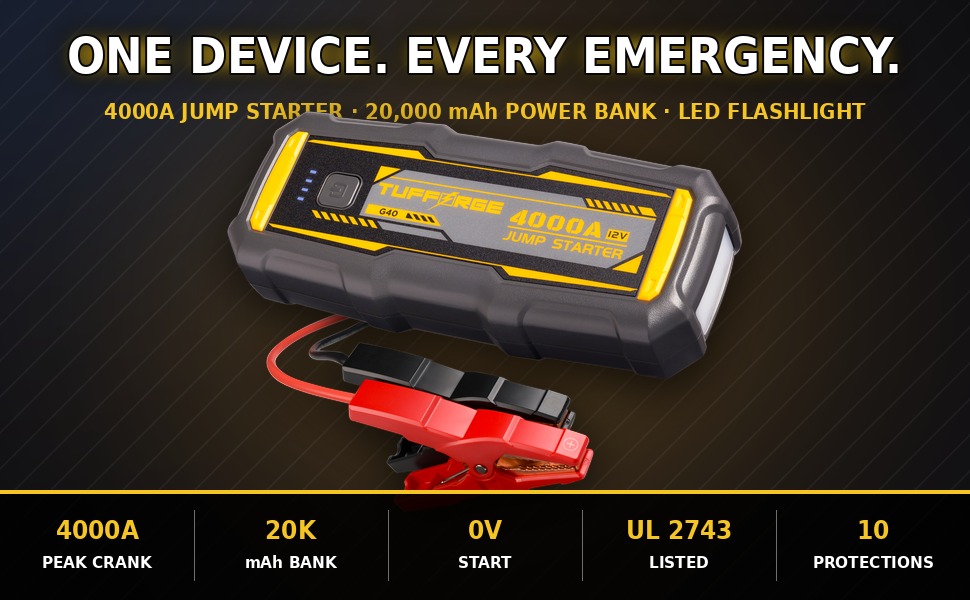
Tufforge G40 — 4000A Peak
Sized for the worst case in the table above. Starts diesels up to 8.0L, gas up to 10.0L. UL 2743 certified, smart-clamp polarity protection.
How to read your battery's CCA
Every car battery has a CCA rating printed on the top label. As a rule of thumb, your jump starter's peak amps should equal or exceed 2× your battery's CCA for comfortable margin.
| Your Battery CCA | Recommended Jump Starter (Peak) | Why |
|---|---|---|
| 400 CCA (compact car) | 1000–1500A | 2.5× margin |
| 600 CCA (sedan, small SUV) | 1500–2000A | 2.5× margin |
| 800 CCA (V8, full-size truck) | 2000–3000A | 2.5× margin |
| 1000+ CCA (diesel) | 3000–4000A | 3× margin for cold cranks |
Frequently asked questions
Is 1000 amps enough to jump start a car?+
Is 2000 amps enough for a diesel truck?+
Can too many amps damage a car battery?+
How does cold weather affect amp requirements?+
What's the difference between peak amps and cranking amps?+
Sources & references
- SAE J537 — Storage Batteries (cranking amperage test methodology)
- BCI (Battery Council International) Group Size Standards
- Tufforge G40 product specifications