When a battery reads 0V, standard jump starters refuse to connect — their low-voltage safety circuit blocks the attempt. To revive a completely dead battery, you need a jump starter with 0V Boost mode. This sends a trickle current to bring the battery above the voltage threshold, then jumps normally. The Tufforge G40 supports 0V Boost.
Why most jump starters fail on a dead battery
Every quality jump starter includes a reverse-polarity and low-voltage safety circuit. When you connect the clamps, the unit measures the battery voltage before allowing current to flow. If it reads below roughly 2–3V, the circuit assumes something is wrong — a reversed cell, a short, or a critically damaged battery — and refuses to activate.
This is a feature, not a bug. Forcing current into a truly shorted or reversed battery can cause heat, gas venting, or fire. But when your battery is simply deeply discharged (not shorted), this lockout becomes a problem.
| Battery Voltage | State | Standard Jump Starter | 0V Boost Mode |
|---|---|---|---|
| 12.6V | Fully charged | Works | Works |
| 11.5–12.5V | Low charge | Works | Works |
| 9–11V | Very low | Usually works | Works |
| 2–9V | Deeply discharged | Blocked | Works |
| 0–2V | Completely dead | Blocked | Works (trickle first) |
What 0V Boost mode actually does
0V Boost (also called 0V recovery mode or force-start mode) bypasses the voltage-check lockout by delivering a low, controlled trickle current — typically 1–2 amps — into the dead battery. This is enough to raise voltage from 0V to the 2–3V threshold where the jump starter's normal circuitry kicks in.
Once the battery reaches threshold, the unit switches to standard jump-start mode and delivers full cranking current. The whole pre-charge phase takes 60–90 seconds.
Step-by-step: jump starting a 0V battery
- Verify the battery is at 0V, not just dischargedA voltmeter tells you which problem you have. If voltage is above 9V, a standard jump start may still work. Below 2V — or at 0V — you need 0V Boost. The Tufforge G40 also shows the battery voltage on its display when clamps are connected.
- Activate 0V Boost on the jump starter before connectingOn the G40, hold the power button for 3 seconds. The display will show a 0V indicator. Other units may require a dedicated switch or button sequence. Activate 0V mode before attaching clamps — not after.
- Connect red (+) clamp to positive terminalClip to the bare lead of the positive terminal. If there's heavy white or blue corrosion, scrape it off first — the clamp must contact metal.
- Connect black (–) clamp to engine groundAttach to a bare metal bolt or bracket on the engine block. Avoid the battery negative terminal directly — an engine ground reduces spark risk near the battery.
- Wait for the pre-charge cycleWatch the display. The unit will show the trickle charge in progress and signal when it's ready — typically 60–90 seconds. Do not try to start the engine during the pre-charge.
- Start the engineCrank the engine. If it doesn't fire within 3–4 seconds, wait 30 seconds and try again. Repeat up to three times. Consistent failure means the battery has a shorted cell and must be replaced.
- Disconnect, drive 30+ minutesRemove black clamp first, then red. Drive the vehicle for at least 30 minutes. A battery recovered from 0V has almost certainly experienced sulfation — have it load-tested before relying on it.
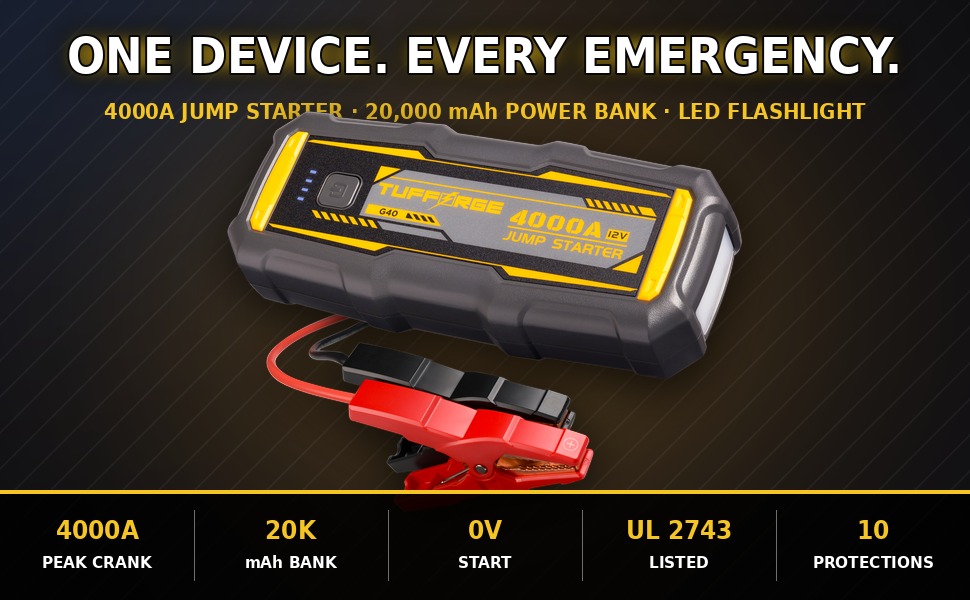
Tufforge G40 — The Only Jump Starter You'll Need
4000A peak. Starts engines up to 10L gas and 8L diesel. 0V Boost mode revives batteries other jump starters reject. UL 2743 certified.
Signs the battery is too dead to save
0V Boost works on batteries that are discharged to 0V but structurally intact. It won't work on batteries with internal damage:
- Cracked or swollen case — the battery is physically damaged and may leak acid. Do not jump, replace immediately.
- Frozen electrolyte — if the vehicle has been in below-20°F conditions, the electrolyte may be frozen. Attempting to charge a frozen battery can cause it to rupture.
- Dead after 0V Boost pre-charge fails to raise voltage — if the trickle charge runs for 2+ minutes and voltage stays at 0V, there is a shorted cell. The battery is unrepairable.
- Battery more than 5–7 years old — even if 0V Boost revives it, the remaining capacity may be so low it won't hold a charge for more than a few days.
After the jump: should you replace the battery?
A battery that reached true 0V has likely experienced sulfation — the buildup of lead sulfate crystals on the plates that permanently reduces capacity. The battery may start your car today and leave you stranded next week.
Any auto parts store (AutoZone, O'Reilly, Advance) will load-test your battery for free. The test applies a cranking load and measures how well the battery holds voltage. If it fails, replace it — the $150–$200 battery cost is far cheaper than a tow.
Frequently asked questions
Why won't my jump starter connect to a completely dead battery?+
What is 0V Boost mode?+
Can you revive a battery dead for weeks or months?+
Is 0V Boost mode safe to use?+
After jump starting a dead battery, do I need to replace it?+
Does the Tufforge G40 have 0V Boost mode?+
Sources & references
- UL 2743 Standard for Portable Power Packs — Underwriters Laboratories
- SAE J537 — Storage Batteries (sulfation and recovery criteria)
- Battery Council International — Deep Discharge and Recovery Guidelines
- Tufforge G40 product specifications and user manual