Jump starter wins for solo drivers — no second car needed, faster, safer for electronics, works anywhere. Jumper cables win on price and simplicity — $15–30, no charging required, never degrade. For most drivers in 2026, a lithium jump starter is the better choice. Cables still make sense as a backup if budget is the constraint.
Head-to-head comparison
| Factor | Jump Starter | Jumper Cables | Winner |
|---|---|---|---|
| Requires second car | No | Yes | Jump Starter |
| Works anywhere (parking garage, highway shoulder) | Yes | Only if second car present | Jump Starter |
| Entry price | $40–160 | $15–50 | Jumper Cables |
| Time to start (after setup) | <60 seconds | <60 seconds | Tie |
| Safety for vehicle electronics | Higher (regulated output) | Lower (depends on donor car) | Jump Starter |
| Performance in cold weather | Reduced (lithium limitation) | Full (donor car limits only) | Cables |
| Requires maintenance | Yes — recharge every 3 months | No — just keep in bag | Jumper Cables |
| Degrades over time | Yes — cells lose capacity | Essentially no | Jumper Cables |
| Can start diesels independently | Yes (high-amp models) | Only if donor is powerful enough | Jump Starter |
| Works as a USB power bank | Most models | No | Jump Starter |
| Works if you're alone | Yes | No (need a helper or traffic) | Jump Starter |
When a jump starter is the clear choice
- You drive solo — the most important factor. Jumper cables require a second vehicle and someone willing to stop. At 11pm in a parking garage, a jump starter is the only option.
- You drive a diesel or large-engine truck — high-amp jump starters (3000A+) can handle diesels without needing a diesel donor vehicle. Cables connected to a gasoline car often can't crank a diesel's higher compression.
- You travel frequently — jump starters work in rental cars, unfamiliar cities, international trips (with adapter). Cables require the entire donor-vehicle equation to solve.
- Electronic safety matters — modern vehicles with complex ECUs benefit from the regulated, voltage-controlled output of a quality jump starter. Cables pass whatever the donor car produces, including voltage spikes from a running alternator.
When jumper cables still make sense
- You always travel with a partner — or frequently drive in convoy. Two-car households where someone can always help have less need for a jump starter's independence premium.
- Budget is the primary concern — a $20 pair of cables works for 30 years with zero maintenance. A good jump starter costs $80–160 and needs quarterly charging.
- You drive in extreme cold regularly — lithium cells lose 20–40% of peak output below freezing. A strong donor vehicle may actually deliver more cranking current to a dead battery than a lithium jump starter at -20°F.
- You want a backup that never fails for other reasons — cables don't have a battery to die. They'll work the day you pull them from a bag you haven't opened in 10 years. A jump starter that hasn't been charged will not.
Why the calculus changed in 2026
In 2010, a good lithium jump starter cost $200–300 and offered 300–400A peak. Today, $80 gets you 2000A peak and 12-month standby. The price premium over cables has collapsed, and lithium energy density has improved enough that even compact units handle full-size trucks.
The only logical reason to choose cables over a jump starter today is cost — and even that is less compelling when you factor in the average roadside assistance call costs $75–150.
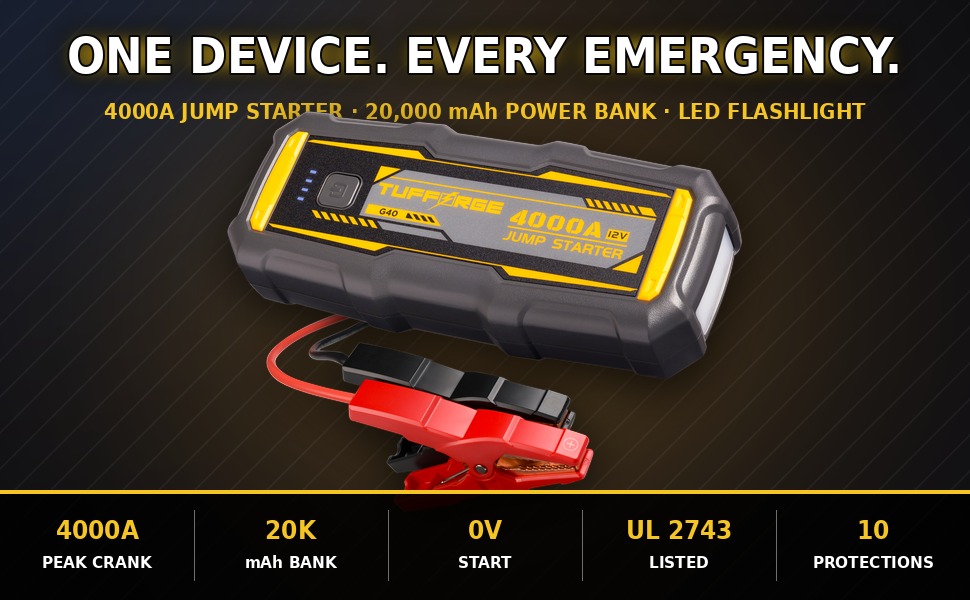
Tufforge G40 — 4000A Peak Jump Starter
Starts gas engines up to 10.0L and diesels up to 8.0L. UL 2743 certified. 0V Boost for completely dead batteries. No second car. No waiting for help.
Our recommendation
For most drivers in 2026: buy a jump starter, keep cables as a backup in the trunk. A quality unit like the Tufforge G40 ($129) handles 99% of scenarios independently. Cables cost $20 and add 6 oz to your emergency kit — they cost you nothing but take up space in case you ever need them.
If you're choosing one or the other: solo drivers, truck owners, and frequent travelers should choose a jump starter without hesitation. Budget-first buyers who always have a partner and a willing driver nearby can get by with cables.
Frequently asked questions
Are jump starters better than jumper cables?+
Can a jump starter damage a car's electronics?+
How much do jump starters cost vs jumper cables?+
Do jump starters work in cold weather?+
What are the downsides of jump starters?+
Should I get both a jump starter and jumper cables?+
Sources & references
- UL 2743 Standard for Portable Power Packs — Underwriters Laboratories
- SAE J537 — Storage Batteries (cranking amperage standards)
- Consumer Reports — Portable Jump Starter Reliability Testing (2024)
- Tufforge G40 product specifications and certified test data